
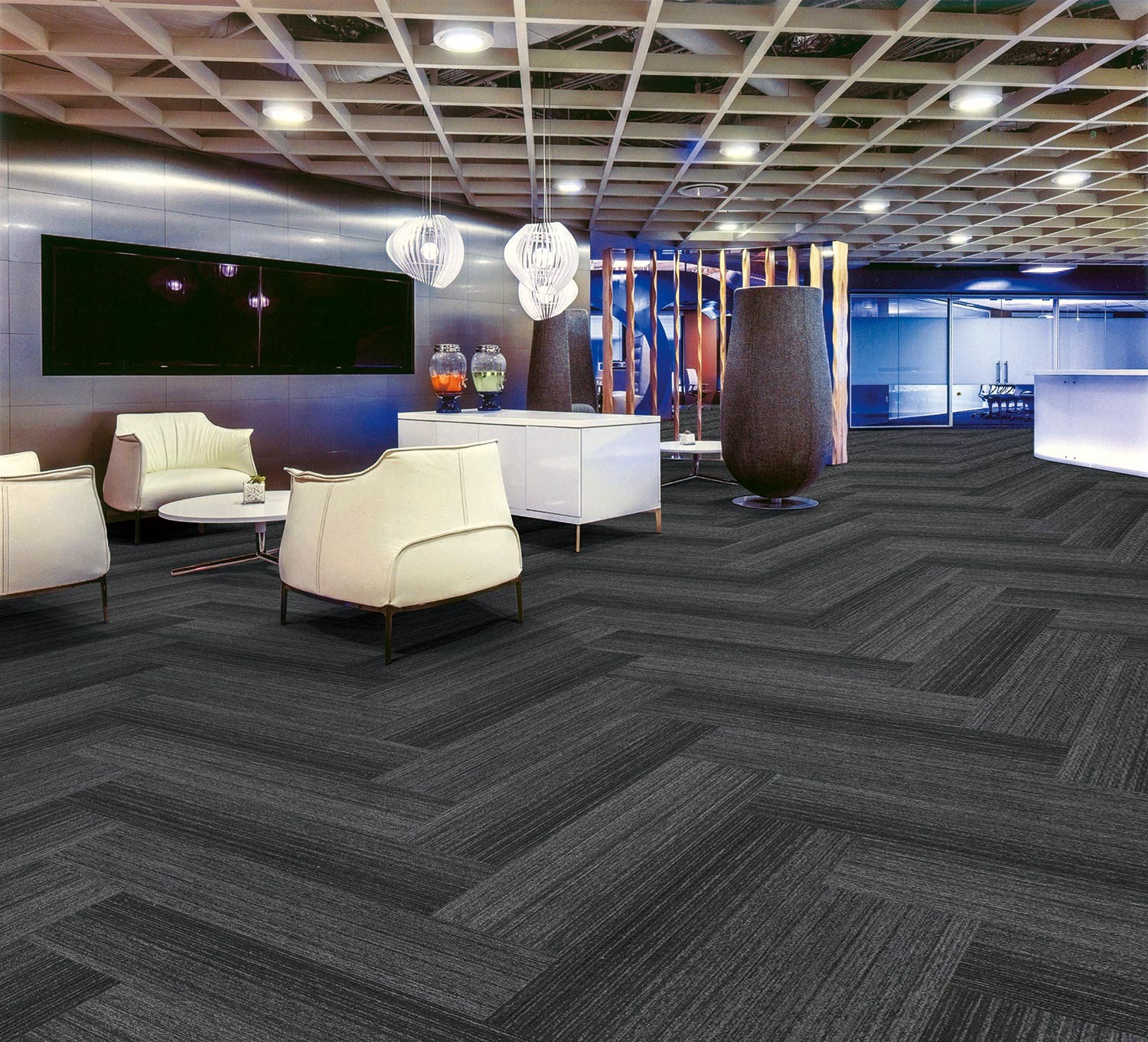
Commercial carpet tiles need to suit the conditions of the space, not simply its appearance. A useful specification considers the room’s function, expected use, cleaning requirements, acoustic demands, and installation conditions. This commercial carpet tile guide covers these factors to help you select a suitable range. Fibre type, backing, pile construction and approved installation methods also influence the suitability of a tile range.
Should performance guide your first carpet tile decision? Start by defining the conditions each floor area must accommodate. A reception has different requirements, while an open office may place greater emphasis on acoustic performance and chair movement. This simple commercial carpet tile guide explains how to match specifications with each space’s requirements.
Assess the following before comparing products:
- Traffic: Identify areas exposed to concentrated or continuous pedestrian movement
- Wear: Account for castor chairs, trolleys, furniture movement and repeated circulation paths
- Spills: Identify locations exposed to food, beverages, mud or other substances
- Cleaning: Consider the available equipment, cleaning methods and expected frequency
- Acoustics: Establish the areas where sound absorption is important
- Safety: Check applicable fire performance and installation requirements for the building
Fibre specification should then be considered alongside the demands of the space. Solution dyed nylon appears across several commercial ranges, with colour incorporated throughout the fibre to support colour retention and stain resistance.
Backing contributes to dimensional stability and influences how the tile interacts with the installation system. Compare backing structure with tile thickness, pile height and the manufacturer’s installation requirements rather than assessing these features separately.
Check Australian Standards when selecting and installing commercial carpet tiles, particularly where legislation makes the standard mandatory. The National Construction Code sets the key technical requirements that apply to building work in Australia.
How Should Different Business Spaces Influence Your Selection?
The function of each room determines which product characteristics deserve the greatest attention. How to choose commercial carpet tiles depends on assessing each zone against its particular use rather than applying one specification across an entire property.
| Business space | Key selection focus | Useful design approach |
| Reception | Appearance, traffic, stain resistance | Structured pattern with darker accents |
| Open office | Acoustic performance, chair movement | Subtle texture with defined zones |
| Corridors | Heavy traffic, soil visibility | Durable construction with practical tones |
| Meeting rooms | Comfort, appearance, acoustics | Refined texture with restrained pattern |
| Retail areas | Traffic, cleaning, visual impact | Patterned layout supporting circulation |
| Education spaces | Wear, cleaning, safety | Durable tiles with clear visual zoning |
For carpet tiles for high traffic areas, such as, in offices, check the product’s stated commercial application and performance rating rather than relying on appearance alone. Sierra and Altitude, for example, use solution dyed nylon with multi-level loop construction. Their specifications identify commercial applications and suitability for heavy traffic.
Corridor specifications should account for concentrated movement along defined routes. A practical surface pattern can also help distribute the visual impact of soil and wear between cleaning periods.
Can Layout and Colour Change How the Space Works?
Carpet tiles allow the floor to contribute to spatial organisation. Changes in tile direction, pattern or tone can distinguish circulation routes from work areas while keeping the flooring visually connected. Commercial carpet tiles can support these arrangements where modular layouts form part of the project design.
Several installation patterns can achieve different effects:
- Brick: Offsets successive rows to create directional movement
- Ashlar: Places tiles in aligned rows for a more ordered appearance
- Quarter turn: Rotates tiles to introduce directional variation
- Colour zoning: Uses tonal differences to distinguish functional areas
- Accent layouts: Places stronger tones at selected focal points
The available pattern depends on the product range. Sierra, Paragon and Altitude specify quarter turn, brick or ashlar installation methods, so the manufacturer’s instructions should determine the permitted arrangement for the selected tile.
Colour selection should account for the type of debris and marking expected in each area. Very pale surfaces can make marks more apparent, while very dark flooring can reveal light debris. Pattern scale and tonal variation can be considered alongside these conditions when selecting a finish for busy areas.
When Should Carpet Tile Replacement and Installation Needs Consideration?
One of the practical considerations with modular flooring is access to individual tiles for future repairs. Localised damage can be addressed by replacing affected tiles rather than removing an entire carpeted section. Retain spare tiles from the same batch where practical and store them in line with the manufacturer’s recommendations. This can help with future repairs where later production may differ in colour or specification.
Installation conditions require equal attention. The subfloor should be assessed and prepared to the manufacturer’s requirements before installation. Uneven surfaces, moisture and contamination can affect adhesion and finished floor levels.
Before installation, request confirmation of:
- Subfloor preparation requirements
- Moisture assessment requirements
- Adhesive compatibility
- Approved installation patterns
- Cleaning instructions
- Warranty conditions
- Replacement tile availability
Maintenance planning should also account for how soil enters the building. Entrance matting can reduce the amount of soil transferred onto carpeted areas, while cleaning schedules can be set according to actual use rather than an arbitrary interval.
Select a Specification That Fits the Whole Project
A commercial carpet tile specification should be assessed as a complete system. Review the technical documentation for fibre, backing, thickness, pile construction, approved installation methods, warranty conditions and stated area of use.
For multi-room projects, compare the requirements of each area before selecting a common range. A product that suits an office may not provide the same practical fit for a heavily trafficked corridor or retail environment. The visual result should be considered after the technical requirements have been established. This keeps the specification focused on how the flooring needs to perform in each part of the building.
This commercial carpet tile guide can support the final selection by keeping technical and room specific requirements in focus.
Need help narrowing down suitable products for your project? Contact CarpetAce to discuss your space, flooring requirements and suitable commercial flooring options.
FAQs
1. What should be considered when specifying carpet tiles for a multi-room project?
Assess the requirements of each room before selecting a suitable product range. Comparing traffic levels, room functions, acoustic demands, cleaning needs and design requirements can help establish where specifications need to differ.
2. Can carpet tiles help define different areas within an open plan workplace?
Yes. Different tile directions, patterns or tones can distinguish work areas, circulation routes and shared zones. The layout should follow the floor plan and remain consistent with the manufacturer’s approved installation methods.
3. What information should be checked in a carpet tile technical sheet?
Review the stated commercial application, fibre type, backing, thickness, pile construction, performance rating, approved installation patterns, warranty conditions and recommended areas of use. These details provide a clearer basis for comparing products.
4. Should one carpet tile specification be used throughout a commercial property?
Individual areas can have different requirements based on their function and level of use. Comparing each room separately can identify where a particular specification is more appropriate.
5. How can carpet tile patterns affect the appearance of a busy area?
Pattern scale, direction and tonal variation influence how the floor presents visually across a large area. A considered pattern can help distribute the appearance of marks and wear rather than drawing attention to isolated areas.
6. Can carpet tiles be compared directly with broadloom carpet?
Both can be considered for commercial interiors, but their construction and replacement methods differ. Carpet tiles provide individual tile replacement and modular layout possibilities, which can influence their suitability for projects.